Patient safety in the San Ramon Valley’s outpatient clinics, dentistry offices, urgent care facilities, and regional hospitals depends on prompt, coordinated response to medical emergencies. The American Heart Association (AHA) created Basic Life Support (BLS), a specialist resuscitation training program for medical professionals and emergency personnel who must identify cardiac or respiratory arrest and act before more advanced care can be provided. Choosing a suitable AHA BLS course guaranties both practical resuscitation readiness and adherence to institutional compliance criteria for clinicians and clinical students seeking BLS Certification Renewal or initial training in Danville.
How BLS Skills Protect Patients Across Danville’s Clinical Settings
Many clinical settings in Danville and the adjacent San Ramon Valley function as outpatient, specialty, or dental facilities, in contrast to acute hospital wards that have specialized code teams on every floor. If a patient has severe airway blockage, syncope that progresses to respiratory arrest, or sudden cardiac arrest, every member of the staff—from doctors and registered nurses to medical assistants and dental hygienists—actively participates.
Primary care clinics, outpatient specialty practices, rehabilitation centers, and multiple dentists and oral surgery businesses along Diablo Road, Hartz Avenue, and Camino Ramon comprise Danville’s healthcare ecosystem. Additionally, Danville residents who work in healthcare often commute to large regional medical facilities along the Interstate 680 corridor, such as John Muir Health, Walnut Creek Medical Center to the north and San Ramon Regional Medical Center in nearby San Ramon.
Across both outpatient clinics and regional acute-care facilities, Basic Life Support Training translates directly into clinical preparedness:
- Outpatient Medical and Urgent Care Clinics: Medical assistants, nurse practitioners, and clinic nurses rely on BLS protocols to quickly verify unresponsiveness, check for normal breathing and a carotid or femoral pulse, activate emergency medical services (EMS), and initiate chest compressions while retrieving an Automated External Defibrillator (AED).
- Dental and Oral Surgery Offices: Because dental procedures frequently involve local anesthetics or sedation, dental teams benefit from structured training in airway positioning, pocket-mask and bag-mask ventilation, and coordinated emergency role assignment.
- Hospital and Inpatient Units: Nurses, physicians, respiratory therapists, and clinical technicians depend on standardized Healthcare Provider CPR Training so that multiple responders can execute seamless, synchronized resuscitation during the critical first minutes of an in-hospital emergency.
- Allied Health and Nursing Students: Students enrolled in regional nursing, respiratory therapy, or dental programs typically must present current AHA BLS course completion documentation prior to starting clinical rotations at Bay Area facilities.
Because each hospital system, medical group, and academic institution enforces its own credentialing and onboarding rules, clinicians should always confirm specific course requirements with their employer or program coordinator.
Distinguishing Healthcare-Provider BLS from General-Public CPR
One of the most frequent administrative hurdles for new healthcare hires and clinical students is completing a general-public CPR course instead of a healthcare-provider BLS course. Although both teach chest compressions and AED operation, their scope and clinical expectations differ substantially.
General-public CPR courses (such as AHA Heartsaver® programs) are built for workplace safety responders, teachers, coaches, and community members. By contrast, an AHA BLS Provider course is tailored specifically to medical professionals and covers:
- Simultaneous Breathing and Pulse Assessment: Checking for absent or abnormal breathing (such as agonal gasps) while simultaneously palpating a pulse for no more than 10 seconds before beginning compressions.
- Bag-Mask Device (BVM) Ventilation: Delivering effective rescue breaths using both one-rescuer and two-rescuer bag-mask techniques, requiring proper airway opening and an airtight mask seal.
- High-Performance Team Dynamics: Assigning clear clinical roles—such as compressor, airway manager, AED operator, and team leader—and using closed-loop communication during multi-rescuer resuscitation.
- Age-Specific Resuscitation Protocols: Performing single-rescuer and two-rescuer CPR across adults, children, and infants, including specific compression-to-ventilation ratios and pediatric AED pad placement.
Individuals who work outside clinical healthcare environments generally do not need a healthcare-provider BLS course unless mandated by their employer, whereas patient-facing medical personnel are almost universally expected to complete BLS Training for Medical Professionals.
Essential Resuscitation Concepts Covered in AHA BLS Training
Whether taking an initial course or attending BLS Renewal Classes Near Danville, learners review and demonstrate core competencies grounded in current American Heart Association resuscitation science.
High-Quality Chest Compressions and Recoil
During cardiac arrest, effective CPR keeps the heart and brain receiving essential blood supply. In order to maintain the highest possible chest compression percentage, training focuses on administering compressions at the optimal pace and depth for adults, children, and newborns, allowing full chest wall recoil after each compression, and minimizing interruptions.
Effective Rescue Breathing and Airway Relief
Clinicians practice delivering measured breaths over one second—just enough to produce visible chest rise—while avoiding hyperventilation, which can impair venous return to the heart. The curriculum also covers recognizing and relieving severe foreign-body airway obstruction (choking) in responsive and unresponsive patients of all ages.
Safe and Rapid AED Operation
Early defibrillation significantly improves outcomes for shockable rhythms. Learners practice powering on an AED immediately upon arrival, applying adult or pediatric pads accurately, clearing all team members before rhythm analysis and shock delivery, and resuming chest compressions immediately afterward.
Initial BLS Training vs. BLS Renewal: Planning Your Timeline
Healthcare providers searching for BLS Classes Near Danville generally need either an initial BLS Provider course or a renewal course to update an existing AHA Course Completion eCard. Understanding the distinction helps prevent scheduling delays or compliance lapses.
- Initial BLS Provider Course: Designed for nursing students, medical assistants, new clinical graduates, and healthcare personnel taking AHA BLS for the first time. The curriculum introduces foundational resuscitation concepts, equipment handling, and step-by-step skill development without assuming prior BLS training.
- BLS Renewal Course: Built for active healthcare professionals who already hold a current AHA BLS Provider eCard and need to refresh their skills and update their course completion record. Renewal focuses on reviewing updated AHA guidelines, reinforcing high-quality CPR mechanics, and verifying practical competency.
An AHA BLS Provider Course Completion eCard is generally valid for two years from the month of issue. Because hospitals and clinical facilities typically require uninterrupted documentation for active staff, checking the recommended renewal date on your existing eCard well ahead of time is essential. Before enrolling in BLS Renewal for Healthcare Providers, verify your current eCard status and confirm whether your employer or school specifies particular course format rules. Keep in mind that an AHA Course Completion eCard documents successful completion of AHA course objectives; it is not a state professional license or clinical board credential.
Finding AHA BLS Training Options in Danville, CA
Healthcare providers and clinical students in Danville and the surrounding San Ramon Valley can access American Heart Association BLS training locally through Safety Training Seminars. Conveniently situated in downtown Danville near Front Street and Interstate 680, the training center serves clinicians commuting from Danville, Alamo, San Ramon, Blackhawk, and Diablo.
Local Training Center Information:
- Safety Training Seminars – Danville CPR Training Center
- Address: 185 Front Street, Suite 187D, Danville, CA 94526
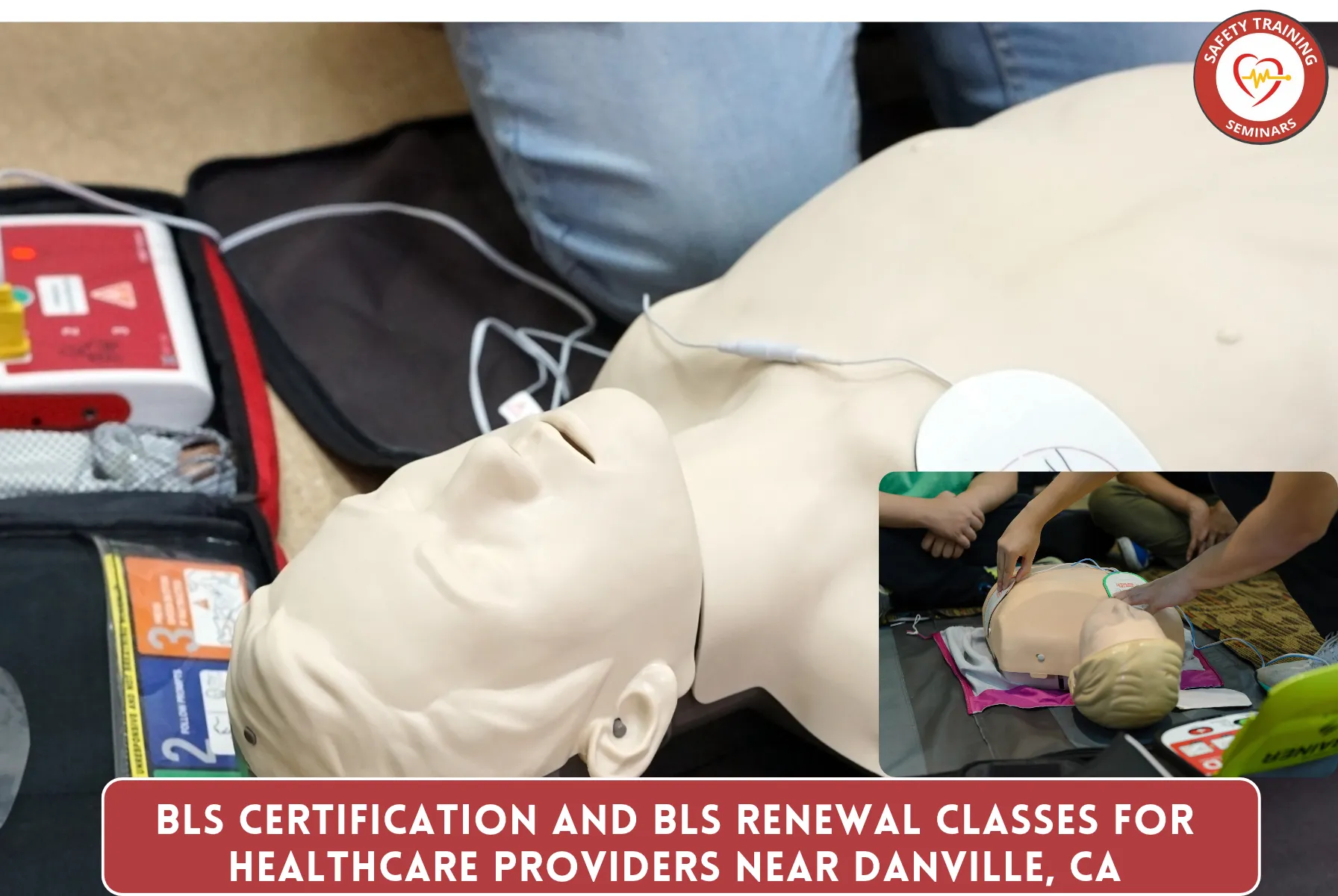
American Heart Association BLS Provider initial and renewal options, such as HeartCode® Complete with Self-Guided LearningTM and a CPR Verification StationTM, are provided by Safety Training Seminars using contemporary blended learning and automated skills verification. In addition to completing the cognitive portion of the AHA curriculum, this arrangement allows physicians to use real-time feedback manikins to validate their practical chest compression and ventilation performance. An official AHA Course Completion eCard is given to students who fulfilll all cognitive and practical requirements.
Because available dates, learning formats, and enrollment details vary, healthcare providers should visit the BLS Certification Course Near Danville page to review current offerings and register.
Frequently Asked Questions About BLS Training Near Danville
Who is required to take an AHA BLS Provider course?
An AHA BLS Course is intended for healthcare professionals and students involved in direct patient care or emergency response. Common participants include registered nurses (RNs), licensed vocational nurses (LVNs), physicians, nurse practitioners, physician assistants, dentists, dental hygienists, medical assistants, physical and respiratory therapists, EMTs, and nursing or allied health students preparing for clinical placements.
What is the difference between a BLS Course Completion eCard and a professional license?
An AHA Course Completion eCard confirms that a learner has met the cognitive and hands-on psychomotor standards of an American Heart Association BLS Provider course. It functions as a training completion record rather than a state-issued professional license or regulatory credential. Most healthcare employers and clinical programs require an active eCard as part of workplace compliance.
How can I verify if I am eligible for a BLS renewal class?
BLS Renewal Training in Danville is intended for healthcare providers who have previously completed an AHA BLS Provider course and need to update their training before their current eCard expires. Check the issue and recommended renewal dates printed on your existing AHA eCard, and confirm any specific renewal timing rules with your employer or academic institution before registering.
Can nursing and allied health students take BLS training in Danville before clinical rotations?
Yes. Students entering nursing, dental hygiene, medical assisting, or other clinical programs frequently complete an initial BLS Course for Nurses and healthcare students before starting hospital or outpatient rotations. Students should verify their school’s exact documentation deadline and AHA course requirements prior to enrolling.
What hands-on skills are evaluated during an AHA BLS course?
During the practical evaluation, learners must demonstrate high-quality single-rescuer and two-rescuer CPR for adults, children, and infants, effective rescue breathing with a pocket mask and bag-mask device, and safe operation of an Automated External Defibrillator (AED) in accordance with current American Heart Association guidelines.
Stay Prepared for Clinical Emergencies in the San Ramon Valley
Sustaining current proficiency in Basic Life Support promotes patient safety in Danville’s clinics, dental offices, and nearby East Bay medical facilities. Verifying your workplace needs early guarantees a smooth procedure, whether you are arranging your BLS Certification Renewal to maintain your documentation up to date or completing BLS training for the first time prior to clinical rotations. Go to the Safety Training Seminars Danville CPR Training Center page to register for upcoming BLS training, explore available dates, and see the various course selections.